Unc Status Revoked: How Science is turning back the clock
December 27, 2025
Intro
Want your TikTok brainrotten mind blown?
GTA Vice City is now closer to the '80s it portrays than it is to today.
Yeah, you've unlocked unc status. You're old news now, champ, it's over.

Me? I'm 28 as I write this. I don't feel old yet, but the idea of my body and mind slowly crumbling has been something that disturbed me ever since I was a kid.
And the true horror is watching it happen to everyone around me. Seeing your parents or grandparents slow down, forget names, or struggle with things that used to be easy just hits different.
Quick question, to set the tone - would you give them a pill to make them all young again? Or one that would make them less worn out by age? Would you take the pill?
I never brought this up before because most people kinda seem to be ok with it, or as I've come to learn, nobody wants to think about it for too long.
But, being passionate about biology, science and, well, existing, I figured it's finally time to address it. And more people should talk about it, because I truly think we're at a point where we could actually fix it, or at the very least slow it down significantly.
And before saying "but aging is natural, bro, just let it happen", so was polio, and we cured the damn thing. Stop pretending that everything natural is good. I will fight you, in real life.
But you can't defeat an enemy you know nothing about, so...
What is aging, actually?
Note: This article is ridiculously long and still barely scratches the surface. Aging is complicated as hell.
For most of human history, it was a vague mystery. Even somewhat recently, people pointed to DNA damage or telomere shortening (very good guesses, but only part of the picture).
This all changed around a decade ago, with the Hallmarks of Aging, a framework that broke it down into 12 specific, measurable failures:
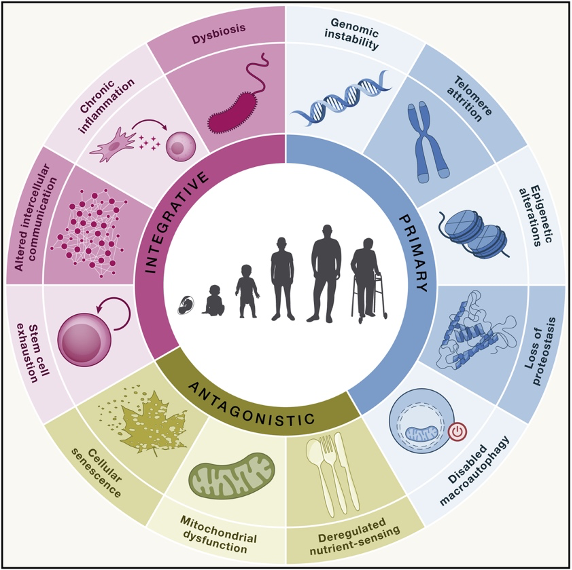
- Genomic Instability: DNA breaks/mutations from radiation, errors, toxins
- Telomere Attrition: Chromosome end-caps shorten, limiting cell division
- Epigenetic Alterations: Gene expression "software" drifts (DNA methylation changes)
- Loss of Proteostasis: Protein quality control fails; misfolded proteins pile up
- Disabled Macroautophagy: Cells stop recycling damaged parts
- Deregulated Nutrient Sensing: Insulin/mTOR pathways overactivate, wrecking metabolism
- Mitochondrial Dysfunction: The powerhouses of the cell become leaky, producing damaging reactive oxygen species
- Cellular Senesence: "Zombie" cells that aren't dividing and secrete toxins accumulate
- Stem Cell Exhaustion: Repair factories run dry
- Altered Intercellular Communication: Cells mis-signal each other
- Dysbiosis: Gut microbiome imbalance that fuels inflammation
- Chronic Inflammation: Everything's on fire
There's also a final boss: lipofuscin. Indigestible junk (oxidized fats, proteins, metals) from failed cellular cleanup. It fills long-lived cells (neurons, heart, retina, muscle). Basically, all cells that don't get killed off and have to live with their mistakes. This starts in early adulthood and grows linearly. It hits 30% cell volume by age 80. This doesn't cause aging in itself, but it adds more fuel to the fire.
If all of this sounds bad, it's because it is. Aging is #1 cause of all-cause mortality. In fact, your risk of dying roughly doubles every eight years after early adulthood (yes, it's an exponential curve), and yes, it's all thanks to aging. I should also mention it's the #1 cause of cancer, diabetes, Alzheimer's and so much more.
Now that we know what we're up against, let's talk about who's fighting it and how.
The Research: Biogerontology as a Scientific Field
Aging research, formally called biogerontology, is an established academic discipline with dedicated PhD programs, peer-reviewed journals, and research institutions at major universities like Stanford, Harvard, MIT, and the Salk Institute.
The National Institute on Aging (NIA), part of the NIH, funds billions in aging research annually.
And it's not just academics in labs. This has gone corporate.
Companies like Altos Labs (backed by Jeff Bezos), Calico (Google's longevity subsidiary), Unity Biotechnology, Genentech, and Cambrian Biopharma are pouring billions into aging research.
These aren't startups gambling on moonshots,they're established biotech firms with regulatory pathways, clinical trials, and FDA engagement.
They're treating aging like any other disease: identify the mechanisms, develop interventions, run trials, get approval.
The Longevity Movement: Longevity Advocacy and Public Awareness
The science is happening in labs and clinical trials.
But science alone doesn't drive change; it needs funding, policy support, and cultural shifts.
That's where the longevity advocacy movement comes in.
For the most part, the longevity movement isn't some sci-fi cult dreaming of immortality, or conspiracy nutjobs selling you weird supplements. It's a loose network of patient advocacy groups, online communities (like r/longevity), science communicators making YouTube videos, bloggers writing about the progress, and policy advocates pushing for increased research funding and regulatory reform.
It's people making others aware that aging is a real problem with real momentum behind solving it.
Since we're here, you can get the latest longevity research news from Lifespan News or watch Dr. Brad Stanfield's videos.
He's a practicing MD from New Zealand who takes an evidence-based approach, critically analyzing human clinical trials rather than overhyping mouse studies or supplement claims.
I can't talk about this movement without also addressing its most polarizing figure: Bryan Johnson.
You know him, and if you don't, he's the tech millionaire vampire spending ~$2M a year to make himself younger.

He's controversial, and some of his methods are extreme and highly experimental. But beyond the headlines, he gives genuinely useful advice that costs nothing: sleep 8 hours, stop smoking, eat whole foods, exercise consistently. These basics legitimately slow aging and are the first step to living a healthier and ultimately longer life. He also does a great job educating people on the science behind why these things matter, and keeps his audience up to date on the latest longevity research and breakthroughs as they happen.
But more than anything, here's what I think matters:
A decade ago, saying "I want to stop aging" got you laughed out of the room. He helped change that. He put longevity on the map for millions of people who'd never heard of biogerontology, and that cultural shift is bringing real funding, attention, and legitimacy to the researchers actually running the trials we're about to discuss.
So where exactly are we?
The progress - exceeding expectations
I'm gonna start this chapter by saying we know a way to reverse aging exists for sure - when people are born, they're not the age of their parents, they start at age 0. What's uncertain is how difficult it is to actually make it happen in already aged adults.
If you want the full nerd spreadsheet of every therapy, company, and trial tackling every single hallmark, check out this Rejuvenation Roadmap from Lifespan.io. You can just skip this section if you're into that, because I'm just gonna highlight the stuff that excites me the most.
Teeth regrowth is my personal favorite "holy shit" moment. Toregem Biopharma's USAG-1 antibody is in Phase 1 human trials right now (started Sep 2024). It works by inhibiting a protein that usually stops tooth growth, waking up the dormant tooth buds adults still have. Even though this isn't related to aging itself, you can imagine how the ability to regrow teeth comes in handy as you're getting older. Actually, you might already wish for it.
This is strong proof that we can regrow complex organs and not just "patch" things up.
Partial Epigenetic Reprogramming: The epigenome consists of chemical tags and modifications that control how DNA is read without changing the genetic code itself. Over time, this system gets "corrupted" by accumulated errors, leading to wrong DNA sequences being read, incorrect gene expression, silenced repair genes, and aging hallmarks like inflammation or senescence.
Shinya Yamanaka discovered four key factors in 2006: Oct4 (OCT4), Sox2 (SOX2), Klf4 (KLF4), and c-Myc (cMYC), known as OSKM. These transcription factors reprogram adult cells (like fibroblasts) into induced pluripotent stem cells (iPSCs) by resetting epigenetic marks.
In short, this means he found a way to turn a fully differentiated adult cell, back into a "baby" stem cell. This earned him the 2012 Nobel Prize in Physiology or Medicine.
But there was a catch. If you blast a living animal with OSKM for too long, they lose their cellular identity and grow teratomas (horrific tumors made of teeth and hair) (Not exactly the glow-up we want).
This is where Partial Reprogramming comes in. The idea is to hit the reset button just long enough to clear the errors, but not long enough to erase the cell's identity.
David Sinclair popularized this idea with his "Information Theory of Aging," and his lab famously restored vision in mice using a modified cocktail (OSK, dropping the cancer-causing "M").
But we have to address the elephant: In 2024, Sinclair faced backlash and resigned as President of the Academy for Health and Lifespan Research after pushing unverified claims about a dog anti-aging supplement.
There are also some other controversies related to him pushing NMN, resveratrol and other supplements, despite limited effectiveness.
If you want to follow the the momentum in 2025, look at Altos Labs and their Chief Scientist Juan Carlos Izpisua Belmonte. His team at the Salk Institute pioneered the "cyclic" dosing method back in 2016, and now backed by Bezos-level money, they are the ones doing the heavy lifting to turn this into a safe human therapy.
Drama aside, Sinclair is still great at explaining the concept. So, here is a video of him breaking down how the "epigenetic reset" works, just keep in mind that the field has grown much bigger than just him:
Here's more recent news about what's happening at Altos Labs:
🚨 Update (January 2026): The FDA has cleared the first-ever human trial of partial epigenetic reprogramming therapy. Life Biosciences (co-founded by David Sinclair) will begin a Phase 1 study of their gene therapy ER-100, designed to rejuvenate damaged retinal cells in patients with open-angle glaucoma and non-arteritic anterior ischemic optic neuropathy (NAION). This is a landmark moment for the field. Read more →
Senolytics: A senescent cell is a damaged or stressed cell that permanently stops dividing but remains alive and metabolically active, resisting death signals.
These cells enlarge, form senescence-associated heterochromatin foci (SAHF), accumulate DNA damage, and secrete a senescence-associated secretory phenotype (SASP) that promote chronic inflammation, tissue dysfunction, and age-related diseases like arthritis or cancer.
Senolytics are drugs that selectively kill senescent cells, clearing them to reduce SASP-driven damage and improve tissue function. Pioneered by James Kirkland and Judith Campisi's teams in 2015, early senolytics like dasatinib + quercetin (D+Q) extended healthspan in mice by 36%, alleviating frailty, kidney damage, and osteoporosis without harming healthy cells.
UNITY Biotech's Phase 2 for diabetic macular edema showed actual vision improvement. Yes, you read that right, improvement.
UDP-003: is an engineered cyclodextrin drug that selectively removes 7-ketocholesterol (7KC), a toxic oxidized cholesterol driving atherosclerosis by turning macrophages into foam cells. This action aims to reverse plaque buildup and restore arterial self-repair. Ex-vivo tests showed it working in 15 minutes. This has the potential to hit genomic instability, mitochondrial dysfunction, and the final boss, lipofuscin, all in one go.
Cyclarity Therapeutics (formerly Underdog Pharmaceuticals) develops it. A Phase 1 first-in-human trial (NCT06813339) started in Australia in early 2025 after regulatory approval, testing single/multiple ascending doses in healthy volunteers and acute coronary syndrome patients over 4-28 weeks. Phase 1 readout is expected in 2026, with Phase 2 in 2028.
The timeline:
Teeth Regeneration (Toregem Biopharma)
- Status: Phase 1 Ongoing (Japan)
- Update: Sept 2025 designated "Orphan Drug" by Japan's Ministry of Health, granting priority review.
- Public Access: 2030
Vision Restoration / Senolytics (UNITY Biotechnology)
- Status: Phase 2b Complete
- Update: Mar 2025 results showed +5.5 letter vision gain (functional improvement, not just slowing).
- Public Access: 2029 (Projected post-Phase 3)
Ectopic Organ Regeneration (LyGenesis)
- Status: Phase 2a Ongoing
- Update: Mar 2025 safety board cleared escalation to higher dosing cohorts.
- Public Access: 2030 (Likely expedited for critical liver failure)
Atherosclerosis Reversal (Cyclarity Therapeutics)
- Status: Phase 1 Ongoing
- Update: First-in-human dosing began Jan 2025 in Australia.
- Public Access: 2031 (Est. completion of Ph2/Ph3)
Dermatology Reprogramming (Turn Biotechnologies)
- Status: Pre-clinical / Phase 1 Prep
- Update: Positive FDA engagement in late 2025 for mRNA skin platform.
- Public Access: 2032 (Cosmetic/Dermatology applications first)
Anti-Inflammaging (Anti-IL-11)
- Status: Licensing / Pre-clinical
- Update: Calico (Google) licensed antibody for $596M in 2025 after proven lifespan extension in mice.
- Public Access: 2033 (Est.)
These timelines are based on public info I could find. Personally, I think they're a bit optimistic, but 20 years ago we wouldn't even dare dream of this. The progress has been crazy. And that's because billion-dollar companies are finally invested. It's not just some dude in a garage.
Realistically, FDA approvals would push the timelines back by quite a bit, but there are also other countries where progress could be expedited, so I'm not that worried.
And now it's finally time to talk about...
The Naysayers and their arguments
Most people hear "defeat aging" and picture endless torment from an inability to die. But I can't think of something that's further from the truth. It's literally the exact opposite - living your best life, for as long as you want to, then going out on your own terms. No more bedrotting, waiting to die in a nursing home, no more dementia taking over your mind and no more diapers.
Essentially, you're just removing the suffering and horrors of aging and replacing all of that with choice, dignity and agency.
There are many people giving many arguments about why we shouldn't fight aging. Some are more valid than others. I'm gonna show you the worst of them first, for entertainment value, and then the one I actually think deserves serious consideration.
Overpopulation
Naysayers scream "Overpopulation!" like it's a checkmate, while global fertility rates are crashing: 1.6 kids per woman projected by 2100, way below replacement.
Japan lost ~800k people last year, Italy's shrinking, and China's one-child policy backfired spectacularly. Curing aging first pulls the brakes on that death spiral, and second, it revitalizes the economy (old people can start working again).
I'm not gonna be delusional about it, super-long lives will strain resources if birth rates don't adjust, but currently we're dealing with the opposite of overpopulation.
Bottom line: productive ageless humans solve the pension crisis now, buying time for space colonization, fusion energy, or whatever other solutions humanity develops.
Death gives life meaning.
I've said it once, and I'll say it again: longevity research isn't about making you immortal. You can still die whenever you want. You also have accidents, disease, wars, and various Darwin Awards to worry about, or just deciding you've had enough. What we're fighting is aging, not death itself. Those are different things.
Now, with that out of the way: this argument actively irritates me, because it's akin to me saying that torturing you for a week is going to make you appreciate freedom.
Sure, the contrast might sharpen your gratitude once it's all said and done, but is that the proper way to look at it?
Should we start torturing people to "cure" the widespread depression that society is currently struggling with?
I stole that analogy from this video by CGP Grey, go watch it:
I think this saying became popular because aging was thought of as immutable.
So we've become Stockholm Syndrome sufferers, singing death's praises to cope.
Questioning this mindset is long overdue.
Here's my take: death doesn't give life meaning, it only limits the "amount" of meaning you can extract from it - caps it, effectively.
You can only learn and experience so much and master so many skills.
If you genuinely believe a deadline makes life more meaningful, that's cool. Cure aging, live 200 years, and then exit masterfully.
Now you've got both: extended time and your meaningful ending. You can have your cake and eat it too.
Boredom in Eternity
This ties in heavily with the previous point, and I call BS.
Meaning comes from agency, not from a ticking time-bomb above your head.
Studies consistently show purpose-driven elders live longer, not shorter.
"You'll get bored without death!" is just an excuse to avoid thinking bigger.
Think you can exhaust every possible experience? Someone in the 1700s might've thought the same. How would they feel if they'd be brought to the current year? They'd probably feel stupid for having even entertained the idea. In 200 years, we'll look just as naive.
Playing God/Naturalistic Fallacy
"It's unnatural to fight aging!", I hear it all the time. That's exactly why I mentioned so early in the article in the first place.
I'm sick of encountering it so often, and I think it's the most intellectually lazy argument.
By that logic, we should give up on vacci - oh wait, antivaxxers already beat me to that punchline.
Let me start over: by that logic, we should abandon antibiotics, surgery, eyeglasses, insulin, chemotherapy.
We should also give up every modern amenity: phones, internet, cars, roads, running water, heating, modern building materials, hell, even agriculture and fire.
Yeah, let's ditch 'em all, go fight with sticks and rocks in the cave and die at 30 from infected cuts.
That's "natural."
At some point you have to realize that absolutely everything we do is "unnatural". So why are you drawing a line at aging?
We'll never get there, it's a pipe dream
This is one of the more grounded objections, but I still have to ask: Are you a time traveler?
Did you come back from 2300 just to tell me we failed?
This mindset is the enemy of progress. If we listened to this logic throughout history, we’d still be staring at the moon wondering what it is instead of walking on it.
I am very aware of the complexity of the issue, and the huge risk of actually not "getting there". But, like with everything ambitious, you need a little delusion and optimism to succeed.
Defeatism always guarantees failure.
Only the rich will benefit
Now this one? This is the legitimate concern.
New medical tech always starts expensive, and longevity therapies will likely debut for the wealthy. That's just how innovation works; The first antibiotics, vaccines, and insulin were luxury goods too before becoming generic and accessible worldwide.
The question is: how fast does it scale down? Because unlike yachts or private jets, longevity tech can't stay in the hands of few. The demand is universal, and the timeline is urgent.
Governments drowning in pension crises and aging populations can't afford to let this stay locked behind paywalls.
Most of Europe, Japan, and China are already staring down demographic collapse. They need this to scale fast, or their economies implode, and their countries disappear.
And yeah, billionaires and corporations would love to hoard it.
I've written about their wealth hoarding disorder before.
But here's the thing: unlike hoarding jets and yachts, hoarding aging cures while millions suffer creates a pressure cooker.
If adoption stays slow, you'll see civil unrest unlike anything we've witnessed.
Corporations know this and they'll expedite access - not out of kindness, but because mass rage, regulatory crackdowns, and potential nationalization are worse for their bottom line.
All that said, I really don't know how this would play out. Maybe they'll try and hoard it anyway, and we'll have to fight back harder than we ever have. Maybe they'll see the writing on the wall and democratize access to avoid the mess. I'm just some guy on the internet making educated guesses. But I don't think longevity should be abandoned just because of this concern. The upsides are too great to ignore.
Conclusion
To recap, the longevity movement is gaining momentum, real progress is being made, and I've seen the public perception change for the better, especially in younger demographics.
Many people go a step further, and think aging should be classified as a disease, so more funding can be allocated to it.
With more funding, we'd see lowered chronic disease, cancer rates and a lowered burden on all healthcare systems. Also less pressure on people to "do something with their lives", and more motivation to actually enjoy it, and make it fun.
This deserves the same level of attention that AI has been getting, if not more.
Right now the world is dumping trillions into (hopefully) making silicon smarter, while our bodies crumble as an afterthought.
We're so obsessed with building the future, yet so indifferent about whether we'll actually be around to see it.
This is where you come in.
If you want to be part of the change, start talking about longevity as a critical issue that deserves attention. Share research updates, discuss it with friends and family, write about it. Public awareness drives funding, and funding drives progress.
The more people understand that aging isn't inevitable, the faster we can defeat it and stay with our loved ones a little while longer.
And if you're still not convinced, at the very least, consider the "eliminate suffering in old age" angle. That alone is worth fighting for.
We were told the sunset was a gift
That the fading light was where meaning stayed
But who finds wisdom in the mind’s slow drift?
Or glory in the debt that must be paid?
SEO section
This is designed to capture search intent. If someone Googles "Is aging a disease?" or "When will we reverse aging?", this section helps the bots index your article for those answers.
Key Takeaways on the Science of Longevity
What is Biogerontology? It is the sub-field of biology aimed at understanding the cellular and molecular mechanisms of aging to extend human healthspan and lifespan.
Can we reverse aging? Current research in Partial Epigenetic Reprogramming (using OSK factors) and Senolytics suggests that biological age may be decoupled from chronological age.
Top Anti-Aging Companies to Watch: Altos Labs, Calico Life Sciences, Unity Biotechnology, and Cyclarity Therapeutics are leading the way in regenerative medicine.
Common Hallmarks of Aging: Genomic instability, telomere attrition, and mitochondrial dysfunction are among the 12 primary drivers of biological decline.
The Future of Longevity: With clinical trials for teeth regrowth and atherosclerosis reversal underway in 2025/2026, the first generation of rejuvenation therapies is approaching FDA-level scrutiny.